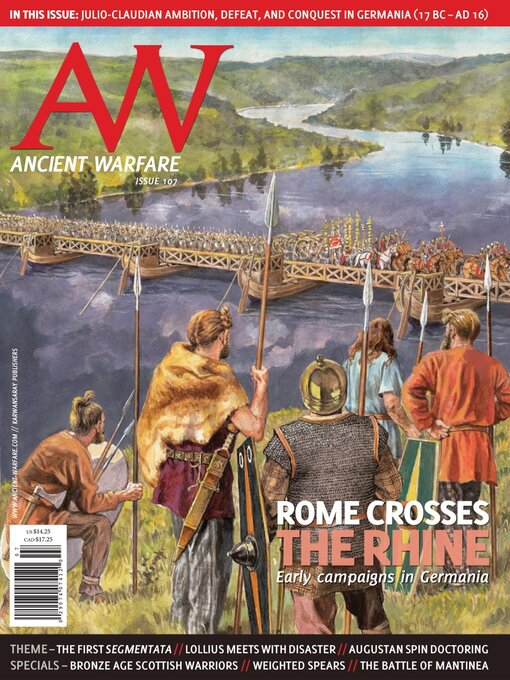
 AW 107
 AW 106
 AW XVIII.5
 AW XVIII.4
 AW XVIII.3
 AW XVIII.2
 AW XVIII.1
 AW XVII.6
 AW XVII.5
 AW XVII.4
 AW XVII.3
 AW XVII.2
 AW XVII.1
 AW XVI.6
 AW XVI.5
 AW XVI.4
 AW XVI.3
 AW XVI.2
 AW XVI.1
Ancient Warfare is a unique publication focused exclusively on soldiers, battles, and tactics, all before 600 AD. Starting with ancient Egypt and Persia and continuing to the fall of the Western Roman Empire, Ancient Warfare examines the military history of cultures throughout Europe, the Middle East and parts of Asia and Africa. Ancient Greece and Rome receive the most frequent coverage, due both to the wealth of contemporary sources and the modern fascination with these two great civilizations. Subject-matter ranges from the familiar to the more obscure: while Alexander the Great, the Persian Wars and Caesar’s Gallic campaigns all receive regular coverage, Ancient Warfare also looks at some of the less common parts of ancient military history, from chariots as battle taxis to PTSD in antiquity.
Ancient Warfare Magazine
EDITORIAL – Taking a trip for pictures
PRELIMINARIES • THE LATEST NEWS AND DISCOVERIES IN THE FIELD OF ANCIENT MILITARY HISTORY
Bronze Age sword reveals master craftsmanship
Weapons of an Armorican warrior discovered in tomb
DID THE NORSE RAID ROMAN-ERA COASTLINES?
Proto-Byzantine fort in Spain
Recycling preserved Roman military gravestones
Sling bullets send a stinging message to the enemy
HAVE YOU READ? • Hippeis: The Cavalry of Ancient Greece
GOING INTO BATTLE WITH PHILLIP II’S ANCESTORS • Many modern studies have addressed the battle history of the phalanx devised by Macedonia’s Philip II and used by his son Alexander III to conquer much of his known world. What is absent from our current literature, however, are in-depth assessments of how Philip’s nation fought prior to his mid-fourth-century-BC reforms. No work concentrates on that earlier period, and those covering later events, at best, provide scarcely more than brief and highly generalized commentary. Typical is the description supplied by The Cambridge Ancient History of the military Philip inherited upon coming to the throne: “Before this time the strength of the army had lain in its cavalry, composed of the ‘companions’ [Hetairoi] of the sovereign — a hereditary aristocracy of land-holders; the infantry had been an ill-organized mass.”
SCOTLAND’S FIRST FIGHTERS • The sword was the first unequivocal weapon in British history, developed about 3500 years ago during the Bronze Age. Before swords, axes, daggers, spears, clubs, and bows and arrows were used for violent purposes, but they were each originally designed for another task. A sword has no function other than harming another human. It has persisted as a weapon ever since.
EUM PARENTEM APPELLAVERO • In the Roman army, bravery in battle could be rewarded in many ways. But in one particular case – the saving of a life – it could take the relationship into new, particularly familiar territory.
EAGLES OVER GERMANIA • The Romans were uninterested in annexing Germania until 17 BC, when warbands crossed the Rhine and threatened the peace in Rome’s Gallic provinces. Coexistence was no longer possible. Launching new military operations was politically convenient for Augustus, however. So began a series of ambitious campaigns that would last over three decades.
THE EARLIEST SEGMENTATA • The lorica segmentata is one of the most enigmatic artifacts in Roman military history. For over two centuries, it was part of the standard armour of Roman legionaries alongside other types, and yet we still know too little about numerous technical details of this type of armour, its history, and its production - we do not even know its original Roman name: lorica segmentata was a term coined in the sixteenth century.
HOW AUGUSTUS SPUN THE GERMAN WARS • In order to safeguard his reputation as an accomplished national leader for all of posterity, Caesar Augustus reframed the German Wars by extolling his diplomatic successes and...